
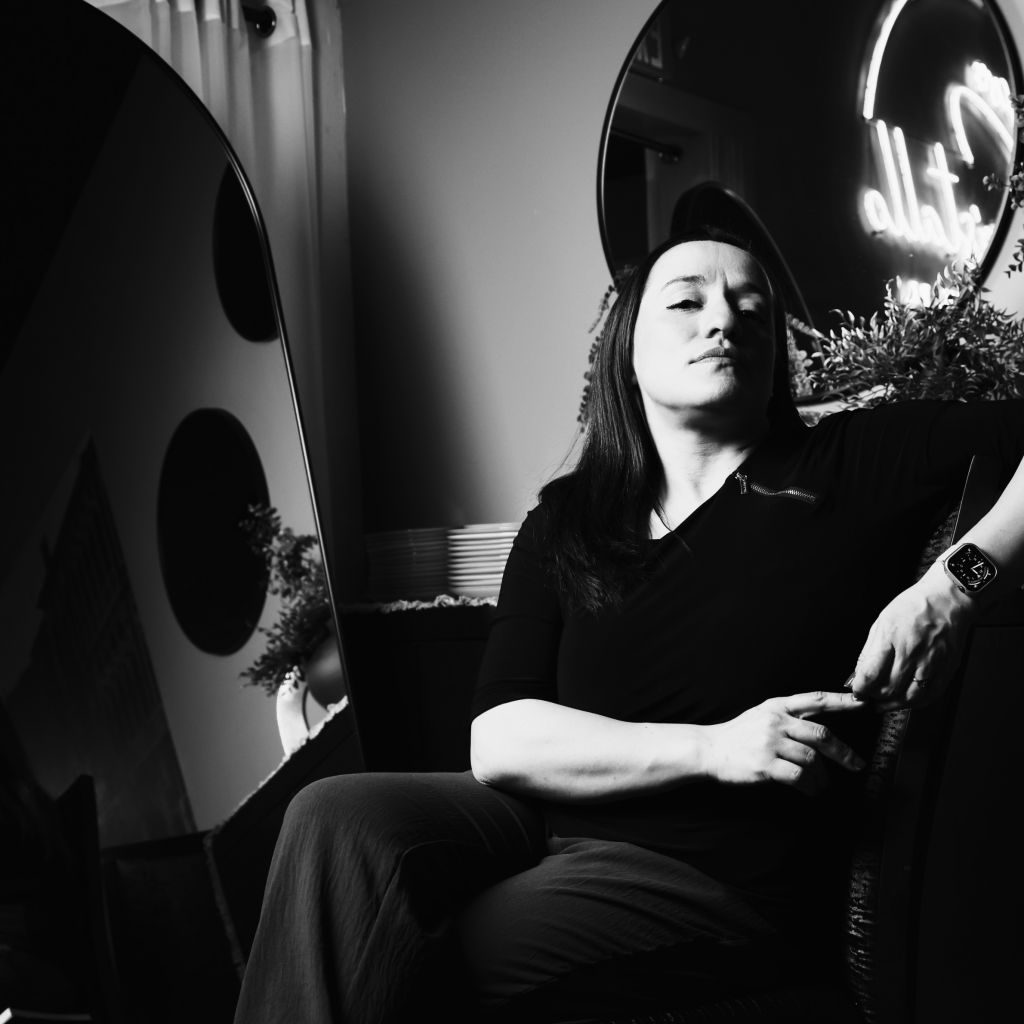
I remember her name clearly, and the color of our uniform. Her name was Claudia Zorro, and the skirt was blue-and-green plaid, Scottish style, a white shirt, blue tie, and a beige blazer. After more than ten years being educated (and spoiled) at the neighborhood school, where the teachers loved me like a silly daughter and the principal still remembers my name even though I finished ninth grade almost 25 years ago, I was forced to look for another school because they didn’t offer tenth and eleventh grade.
At the same time, my family had moved to another neighborhood some time before, so they decided to enroll me in a school closer to the new house. That meant I wouldn’t be attending either of the two schools the rest of my group had chosen. So not only did I have to wean myself off the affection of my lifelong teachers, but I also had to make new friends and adapt to a new environment.
I’ve never been good at making friends. Over the past year, I’ve revisited many stages of my life (in therapy and outside of it), and socializing just doesn’t come naturally to me. I call it introversion and shyness; my family calls it bitterness; my therapist says it’s fear of showing vulnerability. Still, all those labels came later—recently—not when I was 15, when I was just a girl with glasses and big tits who dreamed of meeting an idealized Alejandro Sanz who lived deep inside my writer’s fantasies. My only goal in life was to tell him that his songs inspired me to type epic novels on my mom’s giant typewriter. Because yes, I’ve always been introverted—but with rock star ambitions.
At fifteen, I met Claudia Zorro. I remember she was pretty, though I couldn’t describe her face very well because, honestly, I think my mind blocked that memory. She had two friends; I remember them less, but I do clearly remember that their families were well-off because they talked about trips to the United States and fancy little things. Don’t ask me which things—my brain blocked a lot—but imagine that nowadays they’d have iPhones, designer bags, and Stanley cups. Meanwhile, I had a stereo system hidden at my grandmother’s house because my mom was afraid our few belongings would be seized, so she stored them with her mother. That’s why I spent so much time with my grandma—if I wanted to listen to my Alejandro CDs, I had to go there.
Claudia and her friends checked every box of a teen movie: they were popular, they had money, and she—especially she—had excellent grades. And then there was me, with my clueless face and barely enough money for snacks, but with outstanding grades, impeccable spelling, and an undeniable ability to solve chemistry and math problems. If you ask me now, I barely manage Excel and accounting software, but at fifteen I was the kind of nerd people remember.
I didn’t want to be popular. I didn’t fit the stereotype of the nerd who turns out to be beautiful behind her glasses and ends up with the hottest guy in class. In fact, it was a very small school, and the only guy I found remotely attractive had a girlfriend in his own grade, and I don’t think we ever exchanged a word. I didn’t aspire to join the chess team either. I just wanted to finish high school, earn a college scholarship, and become a writer. I wasn’t interested in Claudia or her friends—but deep down, very deep down, I wanted them to like me.
They didn’t.
I’m not entirely sure of the details (again, PTSD is a brutal thing—no matter how hard I try, I can’t remember everything), but I know they hurt me. From what I do remember: they humiliated me in class; all carefully planned with others; they laughed at me in the courtyard over something involving my food; and they accused me to a teacher of cheating on an essay because “it wasn’t possible that I had written it on my own.” I wasn’t going to bother explaining that my budget barely covered bus fare, let alone paying someone to cheat for me—and if I had to hide a stereo, owning a computer was unthinkable. And questioning my ability to write? Let’s not even go there.
One morning in May, after nearly three months in tenth grade at that school, I woke up with a terrible cold and my mom decided not to send me to class. That night, when it was time to get ready for the next day, I started crying and told her I couldn’t go back. My mom felt the world collapse on her shoulders. Her first thought was that I would follow the path of many family members who dropped out and never had a future—but I reassured her immediately. I loved studying. I still do. I love learning, and there was no way I was going to stop because of a bad experience. But going back there meant allowing them to keep hurting me, and I simply couldn’t take it anymore.
My mom understood, and between tears and laughter she confessed that the decision actually worked in her favor because she was already two months behind on tuition and we couldn’t afford the mandatory blazer that had to be bought at the school and cost three times more than anywhere else. “Without knowing it, they gave you a month and a half of free classes, because I’m not paying that,” she said, and we both smiled. The rest is history. I studied secretarial work, learned English, finished tenth and eleventh grade in a condensed program, went to college, graduated as an engineer, and completed a postgraduate degree. So, no—it didn’t turn out so badly.
Well, I did meet Alejandro Sanz, but we still haven’t sat down to review my writing.
This story has been circling my mind for the past month. Twenty-five years ago, the word bullying was unfamiliar to most of us. Matoneo in Spanish might be an appropriate translation, but putting a name to what happened to me took many years of acceptance and personal work. However, in recent weeks that terror returned in a way both paradoxical and absurd. Out of nowhere, I realized that an American version of Claudia Zorro had been breathing down my neck for nearly two years—a wolf in sheep’s clothing whom I thought I could trust, but who ultimately stabbed me in the back.
That isn’t surprising—those people are everywhere. What truly shocked me was her ability to shape reality to her liking and place me in her story as if I were the devil himself.
When I read her version of events, the narrative was so convincing that I started to dislike myself and even doubt my own existence. I translated the text so my mom could read it, and the first thing she said was, “The person that girl describes is not my daughter—I don’t know her.” Neither do I, Mom. Believe me, neither do I.
I found it particularly unfortunate that my 2026 Claudia Zorro described me as someone who uses others for personal gain, when the real benefit—especially financial—was actually hers, since her pay depended on the number of hours she worked. She had a habit of offering to work as many hours as possible, and I interpreted that as the behavior of a young, energetic person willing to work hard to cover her personal expenses—something admirable, if you ask me. I never believed she was doing it for my benefit, since she earned her money knowingly and by choice.
I know that one of my greatest weaknesses is avoiding confrontation and worrying too much about the consequences—or even assuming that by being kind and avoiding hurt feelings I’m somehow helping people, when in reality it’s the opposite. The clearest example is how I tried in every possible way to keep my predecessor from feeling uncomfortable or threatened by my presence, even though I had been hired specifically to fix the problems caused by his poor management and obvious lack of interest and knowledge.
Perhaps I should have been more direct and not softened the truth. Later, I recognized what appeared to be a clear case of the Dunning–Kruger effect, a theory describing how less competent people tend to overestimate their abilities and believe they do everything well, while more intelligent or skilled people minimize their efforts or underestimate their impact. It’s also known as confident ignorance. It’s an interesting theory, because people like this attack without evidence and rely on arguments that exist only in their imagination—far removed from reality—yet guided by a level of self-confidence I personally envy.
I don’t know (and I don’t think) that the Claudia Zorro of 2026 has any idea what I’m talking about, but what I do know is that this situation reopened an old wound I thought I had closed years ago—and clearly, I hadn’t. Between feeling guilty for not noticing the red flags everywhere, fear disguised as indifference that led me to avoid confrontation, and the constant need for validation I lived with in recent weeks—asking friends and acquaintances if they also saw me as the petty, vile person I was being portrayed as—I realized that deep down I was still that girl in the blue-and-green uniform and big tits, just without the glasses.
I haven’t been able to cry. Well, I did once, in the office in front of one of my bosses—but that was more of a panic attack. But crying over everything I discovered? No. I don’t want to. I haven’t felt the urge. Honestly, I’ve felt a stronger need to write this than to cry.
Maybe they were right. Maybe I am evil. Maybe I am the devil and I’m insensitive. Maybe that’s why making friends is hard for me. Maybe that’s why Claudia Zorro targeted me 25 years ago. Maybe one day I’ll be with Alejandro Sanz presenting my book and she’ll see me on Instagram and say, “Oh look, I knew her—she dropped out halfway through the year and wore glasses,” but she’ll never say it was her fault or that she behaved badly, because people who hurt others not only pretend it’s unintentional, but don’t understand the magnitude of the damage they cause.
I wish no harm on either Claudia—the one from 2001 or the one from 2026. I simply wish not to cross paths with them again or deal with their opinions and judgments. It took me a long time to get here (in this post and in life) to keep dwelling on what they did to me. This is just a release, catharsis, not an act of victimhood. I know I have my share of responsibility, and I’ve learned to be clear about what I’m willing to allow and what I’m not.
Bullying is real, and it almost always comes from people who seem kind and trustworthy. And no, it doesn’t only happen in school or adolescence. The difference in adulthood is that you feel a bit foolish, because by then you should know better—but it’s also easier to verbalize it and, in my case, to turn it into a well-written piece to process and share the experience.
If this has happened to you, comment… classmates, coworkers, family members—this is a safe, judgment-free space. I don’t have credentials to offer therapy, but I do love gossip.
And I know you do too. That’s why you made it all the way here 😊.

 El blog de Érika
Leave a comment